


Last Updated: October 23, 2026
Quick Summary
To build a comfortable and stylish loungewear wardrobe, start with a capsule of about 10 to 14 pieces built on neutral black, gray, and navy, then add one statement piece. Choose midweight fabrics for year-round wear and pair one fitted piece with one loose piece for a flattering silhouette.
- Count your current loungewear first; most people already own six or seven pieces that work.
- Midweight fabric of roughly 150 to 250 GSM is the sweet spot for year-round tees, joggers, and knit trousers.
- Pair one fitted piece with one loose piece so loungewear looks styled instead of sloppy.
- Build one adaptable capsule with base, mid, and outer layers instead of a new wardrobe each season.
- Buy bottoms first, tops second, layers third, and statement pieces last.
Table of Contents
- Start With a Loungewear Essentials Checklist
- Pick the Best Fabrics for Loungewear
- Build a Loungewear Capsule Wardrobe Around Neutrals
- Balance Fitted and Loose Silhouettes for a Flattering Fit
- Loungewear Outfit Ideas You Can Mix and Match
- Plan for Climate, Season, and Real Life
- Spend Smart: Cost per Wear and Buying Priorities
- Care, Repairs, and Making Your Loungewear Last
- Frequently Asked Questions
Start With a Loungewear Essentials Checklist
Building a comfortable, stylish loungewear wardrobe starts with a short list, not a shopping spree. Treat it like a capsule: a small set of pieces that all work together.
This guide from Hippy Mood Merch covers what to buy, which fabrics hold up, and how to mix pieces into outfits.

Here is the core checklist:
- Bottoms: two pairs of joggers or sweatpants, one pair of knit trousers or wide-leg pants
- Tops: two tees, one tank top, one long-sleeve top, one sweatshirt or hoodie
- Layers: one lightweight knit jacket or zip hoodie
That is roughly nine to twelve pieces, enough for almost every chill day, errand run, and late-night session.
How Many Pieces You Actually Need
A workable loungewear wardrobe needs about 10 to 14 pieces, enough rotation to avoid daily laundry without a closet full of unworn items.
Start with 10 if you do laundry weekly; go to 14 for more combinations or a colder climate. Add pieces only when a real gap shows up, not when a sale pops up.
Pick the Best Fabrics for Loungewear
Fabric decides whether loungewear feels good after one wash or one hour. "Soft and breathable" is not enough to compare two pairs of joggers, so use this fiber-by-fiber guide to judge breathability, warmth, stretch, opacity, and durability.
Compare the Core Fibers on Five Traits
| Fiber or blend | Breathability | Warmth | Stretch and recovery | Opacity | Durability |
|---|---|---|---|---|---|
| 100% cotton jersey | High | Low to medium | Low unless knit with elastane | Medium; light colors can show through | Good; softens with washing |
| Cotton-polyester fleece | Medium | High | Medium; brushed back adds bulk | High | Good; pills at friction points |
| Modal or modal-cotton | High | Low to medium | High; drapes and recovers well | Medium | Moderate; can stretch out at cuffs |
| Cotton-rich French terry | Medium to high | Medium | Medium | High | Very good; holds shape |
| Ribbed knit blends | Medium | Medium | High; ribbing adds mechanical stretch | High | Good if the rib is tight |
| Lightweight polyester or satin | Low to medium | Low | Low | High sheen hides wrinkles | Moderate; snags easily |
Read the label with these trade-offs in mind: high cotton means breathability but less recovery, while polyester blends mean durability and wrinkle resistance but more heat retention. Neither is automatically better, it depends on how you run hot or cold and how often you wash.
Match Fabric Weight to the Job
Fabric weight is usually given in grams per square meter (GSM), though many labels omit it. As a rule:
- Lightweight (roughly under 150 GSM): tanks, summer tees, and silky lounge pants. Cool and packable, but thin light colors can be see-through.
- Midweight (roughly 150 to 250 GSM): the sweet spot for year-round tees, joggers, and knit trousers. Drapes well, hides wrinkles, and layers without bulk.
- Heavyweight (roughly 250 GSM and up): fleece sweatpants, hoodies, and cold-weather layers. Warm and structured, but slower to dry and bulky under a jacket.
Build the base in midweight and add one heavyweight layer for cold rooms. If you sleep hot, keep heavyweight to a single hoodie rather than a full set.

Construction Details That Keep Pieces From Falling Apart
Stitching and finishing are where cheap loungewear gives itself away. Check these spots:
- Waistbands: look for a wide elastic band with a matching drawstring, not a thin exposed band that rolls. A covered or encased elastic lasts longer and lies flatter.
- Seams: flatlock or reinforced seams lie smooth against the skin and resist pulling. Single-stitch seams on high-stress areas like the seat and inner thigh are a warning sign.
- Cuffs: ribbed cuffs with spandex keep their shape and stop the "stacked" look from sagging. A plain folded hem stretches out faster.
Test Before You Trust the Tag
You cannot always feel a fabric online, so use these checks:
- The stretch-and-recover test: pull a cuff or waistband gently and release. It should snap back, not stay stretched.
- The light test: hold light-colored fabric up to a lamp. If you can read text through it, it will show through in daylight.
- The rub test: rub two layers of the fabric together for a few seconds. Excessive fuzz means it will pill.
- The weight test: compare the feel of a tee against a known midweight shirt. If it feels flimsy, it probably is.
A tightly knit fleece with a brushed interior resists pilling better than a loose, lofty fleece, the difference between a piece you keep for years and one that fades by spring.
Build a Loungewear Capsule Wardrobe Around Neutrals
Neutrals are the backbone of any loungewear capsule wardrobe. Black, gray, and navy mix with everything, so every top works with every bottom, more outfits from fewer pieces.
Start your palette like this:
| Color | Role | Why It Works |
|---|---|---|
| Black | Base | Hides wear, pairs with any print |
| Carbon gray | Base | Softens the look, easy to layer |
| White | Accent | Brightens an outfit, great under layers |
| Navy | Base | Reads slightly dressier than black |
| One bold print | Statement | Adds personality without breaking the set |
Once the neutrals are in place, add color through one or two statement pieces. A bold lounge pant or graphic hoodie does the heavy lifting while the rest stays quiet and flexible.
Balance Fitted and Loose Silhouettes for a Flattering Fit
The rule that makes loungewear look styled instead of sloppy: pair one fitted piece with one loose piece.
Try these pairings:
- Fitted tank top + relaxed joggers: clean and easy
- Loose tee + straight-leg knit trousers: balanced and modern
- Fitted long-sleeve top + wide-leg pants: comfortable and put together
Watch the drape: fabric that falls smoothly flatters more than fabric that bunches.
Sizing matters: a relaxed fit is not the same as two sizes too big. Check the size guide for waist and inseam measurements, and size up only for a looser drape.
Loungewear Outfit Ideas You Can Mix and Match
Good loungewear outfit ideas come from mixing separates, not matching sets. Once your pieces share a color base, combinations multiply fast.
Hippy Mood Essential Fleece Sweatpants →
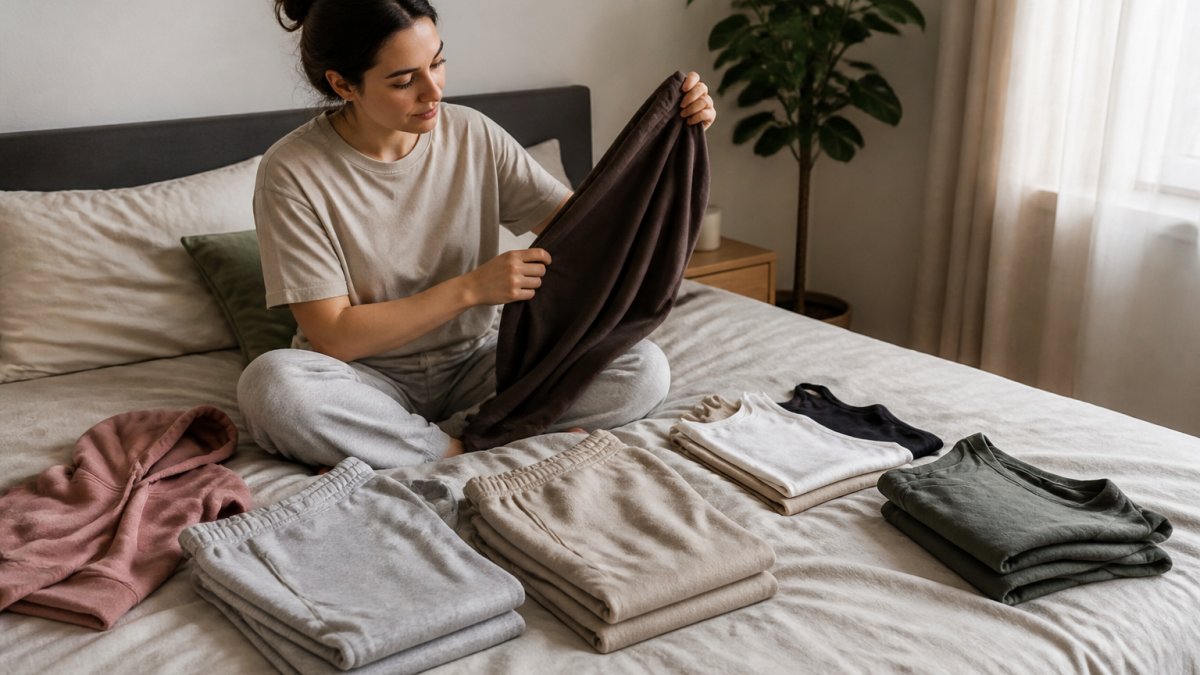
Three outfits to start with:
- The errand run: fleece sweatpants, a fitted tee, and a knit jacket. Comfortable enough for the couch, clean enough for the store.
- The chill night: silky lounge pants, a tank top, and slides. Light, breathable, and easy to move in.
- The layered day: joggers, a long-sleeve top, and a hoodie tied around the waist. Warm, casual, and ready for anything.
Our Hippy Mood Essential Fleece Sweatpants fit the first outfit perfectly. They come in Black, Carbon Grey, and White, so they slot into any neutral base.
For a bolder night, the 420 Baddie Lounge Pants in Night Glow bring the loud color and silky feel.
Plan for Climate, Season, and Real Life
Your loungewear wardrobe should match where you live and how you spend your days. Instead of buying a separate wardrobe for every season, build one adaptable capsule and rotate a few pieces in and out.
Build a Three-Layer Climate System
Think in layers rather than seasons:
- Base layer (year-round): lightweight to midweight cotton or modal tees and tanks. These are the pieces you wear most, so buy two or three in neutral colors.
- Mid layer (transitional): midweight joggers, long-sleeve tops, and French terry crews. They handle cool mornings and air-conditioned rooms.
- Outer layer (cold): a heavyweight fleece hoodie, a knit jacket, or a zip-up. This is the piece you add or remove as the room changes.
Warm months use the base layer alone, transitional weeks add the mid layer, and cold months stack all three. You do not need a new capsule for each season, just the right layers.
Adapt the Capsule to Your Home Climate
Home climate matters as much as outdoor weather: a drafty apartment needs different pieces than a warm, dry house.
- Warm and humid homes: prioritize breathable cotton and modal, loose silhouettes, and light colors that reflect heat. Skip heavy fleece except for one hoodie for cool nights.
- Cold or drafty homes: add a heavyweight fleece set, a knit jacket, and thick socks. Layer a tank under a long-sleeve tee for extra warmth without bulk.
- Dry climates: static and cling are common, so choose natural fibers and avoid low-quality polyester that holds a charge. A light spritz of water before wearing reduces static.
Plan Around Your Real Week
Loungewear is not just for the couch. A clean pair of knit trousers with a fitted top works for a coffee run or casual office day, so choose pieces that can leave the house without looking like pajamas.
Map your week before you buy:
- Work-from-home days: weight the wardrobe toward comfortable tops you can wear on video calls. A collared knit or a clean crew neck reads more polished than a graphic tee.
- Errand and travel days: pick pieces that pack flat and resist wrinkles. Knit trousers and midweight joggers travel better than bulky fleece.
- Evening and rest days: keep one softer, lighter set for lounging and sleep. Silky pants and a tank work here.
Rotate, Don't Rebuy
Keep a core of 10 to 14 pieces and swap two or three items at the start of each season. Store off-season pieces folded with a cedar block or lavender sachet, and check elastic and cuffs before wearing, stored elastic can lose snap.
Spend Smart: Cost per Wear and Buying Priorities
Cost per wear is the real price of a piece. Divide the price by how many times you will wear it.
Set your buying priorities in this order:
- Bottoms first: they take the most wear and tear
- Tops second: you need more of them, but they cost less
- Layers third: one good hoodie or knit jacket covers a lot of ground
- Statement pieces last: buy these once your base is solid
Higher prices are worth it when construction backs them up. Check fabric weight, seams, and the size guide, if a piece is built to last and fits your body, the cost per wear math favors it every time.
Chasing the lowest price on every item means replacing cheap pieces constantly. Buying fewer, better pieces usually costs less over a year.
Care, Repairs, and Making Your Loungewear Last
Good care doubles the life of your loungewear. A few habits keep soft fabrics soft and prints intact.
Follow these rules:
- Wash cold: hot water breaks down fibers and fades prints
- Turn prints inside out: this protects graphic and all-over designs
- Skip the dryer when you can: air drying keeps elastic and cuffs in shape
Small repairs save big money: reattach a loose drawstring, patch a small hole, or replace stretched elastic before it becomes a bigger problem.
Keep your rotation going. Wearing the same piece every day wears it out fast. Rotating through your capsule spreads the wear and keeps every piece looking newer for longer.
Frequently Asked Questions
What are the essential pieces in a loungewear capsule wardrobe?
Start with two bottoms (a fleece sweatpant and a lightweight lounge pant), three tops (a tee, a tank, and a long-sleeve or sweatshirt), and one layer like a knit jacket or hoodie. Add a pair of slides for quick trips out. That's seven to eight pieces that mix into a dozen or more outfits. Stick to neutral colors like black, gray, and navy so everything pairs without thinking. The goal is fewer pieces you actually rotate, not a closet full of one-off sets.
Can you wear loungewear outside the house?
Yes, if you style it deliberately. A heavyweight fleece sweatpant with a fitted tee and clean sneakers reads as streetwear, not sleepwear. The difference is fabric weight, fit, and grooming. Lightweight silky lounge pants with bold all-over prints work for errands and casual hangs when paired with a solid top and slides. Avoid anything that looks slept-in: wrinkled, stretched-out, or paired with house slippers. One upgraded layer, like a knit jacket, makes the whole outfit look intentional.
How do you make loungewear look stylish?
Three moves do most of the work. First, balance proportions: pair a loose bottom with a fitted top, or a baggy sweatshirt with a straight-leg pant. Second, keep colors tight: black, gray, navy, and white mix without effort. Third, pay attention to fit at the waist and ankle, since a clean waistband and a stacked cuff make cheap fabric look expensive. Add one intentional accessory, like a cap or a chain, and the outfit shifts from couch to coffee shop.
What fabrics are most comfortable for loungewear?
Cotton and cotton-polyester fleece are the workhorses: breathable, soft, and durable through repeated washing. Look for a tightly knit 3-end fleece for heavyweight sweatpants, and a soft brushed interior for next-to-skin comfort. For warmer months or a lighter feel, polyester blends at around 90 g/m² stay smooth and breathable. Skip anything scratchy or stiff. Check the label for fabric weight and content before buying, and wash cold to keep the hand-feel intact.
Building a loungewear wardrobe that feels good and looks sharp takes a plan, not a pile of impulse buys. Start with a neutral base, check the fabric and construction, and let a few bold pieces carry your personality. Hippy Mood Merch has been trusted since 2018, and our lounge pants and fleece sweats are built for heavy comfort and higher vibes. Choose your mood and build a wardrobe that works as hard as you chill.
