


Table of Contents
- Why Graphic Tees Break Down in the Wash
- What You'll Need Before You Wash Graphic Tees
- Step-by-Step: How to Wash Graphic Tees Without Cracking
- The Best Detergent for Screen Printed Shirts
- How to Dry Graphic Tees Without Shrinking
- How to Fix Cracked Graphic Tees
- Print Types Matter: Screen Print, Heat Transfer, and DTG
- Water Hardness, Storage, and Eco-Friendly Laundry Options
- Frequently Asked Questions
Last Updated: September 25, 2026
Why Graphic Tees Break Down in the Wash
A graphic tee is a printed garment, and the print is the fragile part. Most shirts don't die from wear. They die in the laundry.
American Cleaning Institute laundry guidance
What You'll Need Before You Wash Graphic Tees
Gather these first so you're not improvising mid-load:
- A mesh laundry bag for delicate prints
- Mild liquid detergent, free of bleach and brighteners
- Cold water (below 30°C / 86°F)
- A drying rack or a clothesline
- A clean, flat surface for air drying
Skip the fabric softener entirely. It coats the print and dulls the ink over time.
Step-by-Step: How to Wash Graphic Tees Without Cracking
The full process takes about 10 minutes of hands-on time per load. Follow these four steps in order, every time.
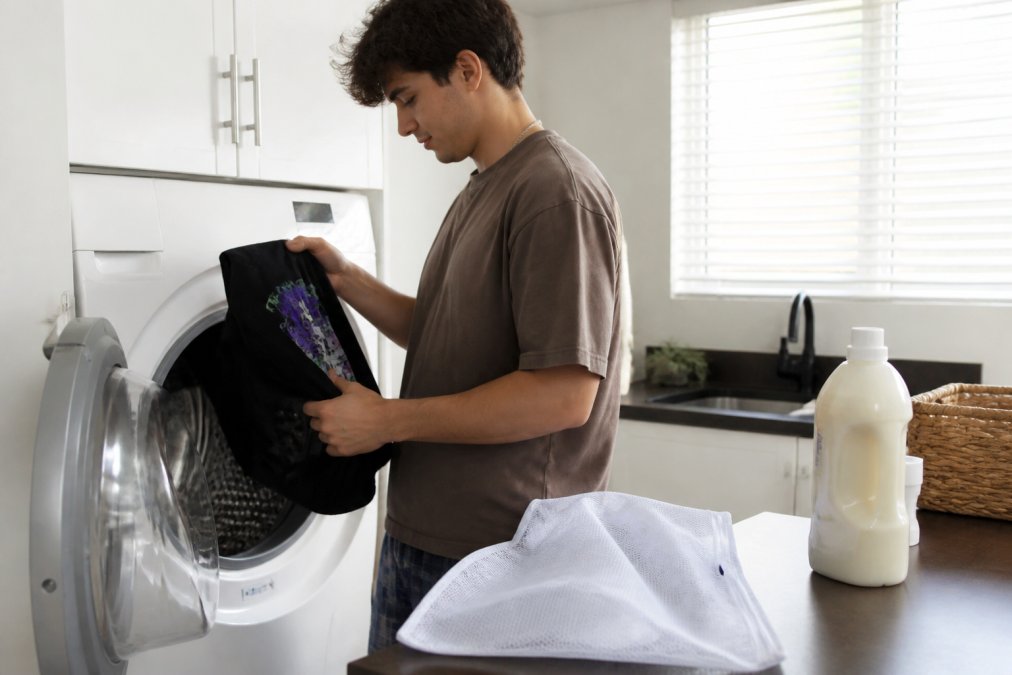
Step 1: Turn the Shirt Inside Out
Turning the shirt inside out protects the print from friction: the ink faces inward, rubbing against soft cotton instead of the drum.
Step 2: Sort by Color and Fabric Weight
Sort by color first, then weight. Dark dyes bleed onto light shirts in cold water too, just more slowly.
Step 3: Choose Cold Water and a Gentle Cycle
Cold water is non-negotiable: it keeps ink from softening and cotton from shrinking.
Step 4: Skip Bleach, Brighteners, and Fabric Softener
Bleach eats color, and optical brighteners leave a chalky film on dark prints. Fabric softener coats the ink and traps detergent residue in the fibers.
The Best Detergent for Screen Printed Shirts
The best detergent for screen printed shirts is a mild, liquid, bleach-free formula. Powder detergents contain abrasive granules that scrub the print during agitation.
Look for these on the label:
- "Free and clear" or fragrance-free
- No bleach or "color-safe" claim
- Liquid, not powder
- No added optical brighteners
How to Dry Graphic Tees Without Shrinking
Air drying is the single best way to prevent shrinking and cracking, dryer heat shrinks cotton and stiffens ink.
Here's the method:
- Gently reshape the shirt while it's damp.
- Lay it flat on a drying rack, print side up.
- Keep it out of direct sun, which fades dyes.
- Let it air dry completely before folding.
U.S. Department of Energy appliance efficiency guidance
How to Fix Cracked Graphic Tees
You can't fully reverse a cracked print, but you can slow it down. Once ink cracks, the damage is permanent. The goal is damage control.
Try these fixes:
- Iron the shirt inside out on low heat to smooth minor lifting
- Use a pressing cloth over the print for stubborn spots
- Wash the shirt less often going forward
- Switch to hand washing for badly cracked pieces
Print Types Matter: Screen Print, Heat Transfer, and DTG
Not all prints behave the same in the wash, the biggest variable is how the ink sits on the fabric. Knowing your print type tells you how much care it needs and where the failure points are.
Screen Print (Plastisol and Water-Based)
Screen printing pushes ink through a mesh screen and cures it under heat, typically around 320°F for plastisol. Plastisol is a PVC-based ink that sits on top of the fabric as a flexible film; water-based screen inks soak into the cotton fibers, giving a softer hand feel but less opacity.
- Durability: High. Plastisol bonds mechanically to the cotton weave and tolerates dozens of washes.
- Best care: Cold wash, inside out, air dry.
- Watch out for: Heat. A hot dryer re-softens the plastisol film, and once it cools in a stretched position, the print cracks along the fold lines. Water-based prints fade faster than plastisol because the pigment is inside the fiber, not on top of it.
Heat Transfer (Vinyl and Digital Transfer)
Heat transfers are printed onto a carrier sheet, then pressed onto the shirt. Vinyl transfers are cut shapes; digital transfers are full-color images on release paper. Both sit on top of the fabric as a layer.
- Durability: Medium. The bond is adhesive-based, not mechanical.
- Best care: Inside out, mesh bag, lowest heat setting available, or air dry.
- Watch out for: Peeling edges. The adhesive weakens with repeated heat cycles and friction. A mesh bag is not optional here, it is the difference between a two-year shirt and a two-month shirt.
DTG (Direct-to-Garment)
DTG printers jet water-based ink directly onto the shirt, and a pretreatment solution helps the ink bind to the cotton. The ink sits partly in and partly on the fibers.
- Durability: Medium. Fades gradually rather than cracking suddenly.
- Best care: Gentle cycle, cold water, no bleach, no fabric softener, air dry.
- Watch out for: Fading and wash-out. Because the ink is water-based, hot water and harsh detergent pull pigment out of the fibers over time. DTG prints on dark shirts also rely on a white underbase, which can crack independently of the color layer.
Sublimation (Polyester Only)
Sublimation ink turns to gas under heat and bonds into polyester fibers, it never sits on the surface.
- Durability: Very high. The print cannot crack or peel because it is inside the fiber.
- Best care: Cold or warm wash, avoid fabric softener (it coats the fiber and dulls the color), avoid high heat.
- Watch out for: Pilling and fading from abrasive washes. The print itself is nearly indestructible, but the polyester it lives in is not.
Quick Reference
| Print Type | Ink Location | Heat Tolerance | Friction Tolerance | Main Failure Mode |
|---|---|---|---|---|
| Screen print (plastisol) | On top of fabric | Low | Medium | Cracking |
| Screen print (water-based) | In the fibers | Low | Medium | Fading |
| Heat transfer | On top of fabric | Very low | Low | Peeling edges |
| DTG | In and on fibers | Low | Medium | Gradual fading |
| Sublimation | Inside polyester fiber | Medium | High | Fabric pilling |
If you don't know your print type, feel the surface. A raised, rubbery film is plastisol screen print or heat transfer; a print that feels part of the fabric is water-based screen print, DTG, or sublimation. When in doubt, treat it like a heat transfer, the gentlest routine works for every type.
Water Hardness, Storage, and Eco-Friendly Laundry Options
Three factors quietly shorten a graphic tee's life, and most wash guides skip them: the minerals in your water, how you store the shirt, and what's in your detergent.
How Hard Water Damages Prints
Hard water carries dissolved calcium and magnesium. During the wash, those minerals react with detergent to form an insoluble soap scum that settles into the cotton fibers, doing three things:
- Stiffens the fabric. The shirt feels rough and board-like even after drying.
- Dulls the print. Mineral film scatters light off the ink surface, so colors look chalky instead of saturated.
- Traps detergent. Residue holds onto soap, which holds onto more residue, and the cycle compounds.
Fixes that actually work:
- Add a water softener designed for laundry, such as a washing soda booster, to each load.
- Use slightly less detergent, hard water needs more surfactant to lather, but over-pouring makes the residue problem worse.
- Run a machine cleaning cycle monthly with a washer cleaner to strip mineral and detergent buildup from the drum.
- Consider a whole-home water softener if hardness is severe. It is the only permanent fix.
Storage: Fold, Don't Hang
Hanging a graphic tee on a wire hanger concentrates its weight on two small points at the shoulders. Over months, that stress stretches the knit and distorts the print near the shoulders and chest. Wire hangers are the worst offender; padded hangers are gentler but still not ideal long-term.
A few more storage rules:
- Keep them out of damp spaces. Basements, garages, and bathrooms grow mildew, which stains cotton and breaks down ink binders.
- Skip plastic bags for long-term storage. Plastic traps moisture and off-gasses over time. Use cotton garment bags or breathable storage boxes instead.
- Store dark prints away from direct light. UV fades plastisol and DTG inks even when the shirt is not being worn.
- Do not stack heavy items on top of folded tees. Compression creases can crack a plastisol print along the fold.
Eco-Friendly Laundry That Is Also Print-Friendly
When choosing a detergent, look for these categories:
- Plant-based liquid detergents formulated without optical brighteners, dyes, or synthetic fragrance. These are gentle on plastisol and water-based inks and biodegrade more readily than petroleum-based formulas.
- Soap nut (wash nut) laundry liquid. A traditional plant-based option that cleans well in cold water and leaves no residue on prints. It is less effective on heavy stains, so pretreat those first.
- Concentrated formulas. Less water in the bottle means less packaging and lower shipping emissions. Use the recommended dose, more is not better for your prints or the environment.
What to avoid in the name of eco-friendliness:
- Homemade detergent with grated bar soap. Bar soap leaves a waxy residue that coats prints and stiffens fabric, especially in hard water.
- Vinegar as a fabric softener substitute. A diluted vinegar rinse can help with odors, but full-strength or frequent use can weaken some ink binders over time. Use it sparingly, if at all.
- Baking soda as a booster in every load. Occasional use is fine, but repeated alkaline washes can dull water-based and DTG inks.
EPA Safer Choice product search
Hippy Mood Merch builds our tees to hold up, but even a great print needs the right routine. Cold water, gentle cycles, and air drying keep the design sharp for years.
Frequently Asked Questions
Can you put graphic tees in the washing machine?
Yes, most graphic tees can go in the washing machine as long as you turn them inside out, use cold water, and select a gentle or delicate cycle. A mesh laundry bag adds extra protection against friction. Avoid hot water and heavy agitation, which break down the print and cause cracking or fading over time.
How do you wash graphic tees without cracking the print?
Turn the shirt inside out, wash in cold water on a gentle cycle, and use a mild detergent without bleach or optical brighteners. Skip fabric softener, which leaves residue that weakens the print. Air dry or tumble dry low. These habits reduce friction, heat exposure, and detergent buildup, the three main causes of cracked graphics.
Are you supposed to wash graphic tees inside out?
Yes. Turning a graphic tee inside out protects the printed design from rubbing against other garments and the washer drum. This simple step reduces friction, which is the leading cause of cracking and peeling. It also keeps the print from snagging on zippers, buttons, or rough fabrics in the same load.
What type of detergent should I use to wash graphic tees?
Use a mild, liquid detergent free of bleach and optical brighteners. For screen printed shirts, a gentle formula labeled for delicates or free-and-clear works well. Powder detergents can leave residue that builds up on the print. Always check the label and avoid anything with added whiteners or fabric softener.
Most graphic tees don't wear out. They wash out, one hot cycle at a time. Hippy Mood Merch has been making expressive streetwear since 2018, and we want every print to last as long as the shirt it's on. Our tees are designed for comfort and self-expression, built to keep their look through real life, not just the first wear. Choose your mood and give your prints the care they deserve.